
YEAR OF UNREST ENDS AS INDIAN NULLIFIES FARM ACTS
Category: Legal News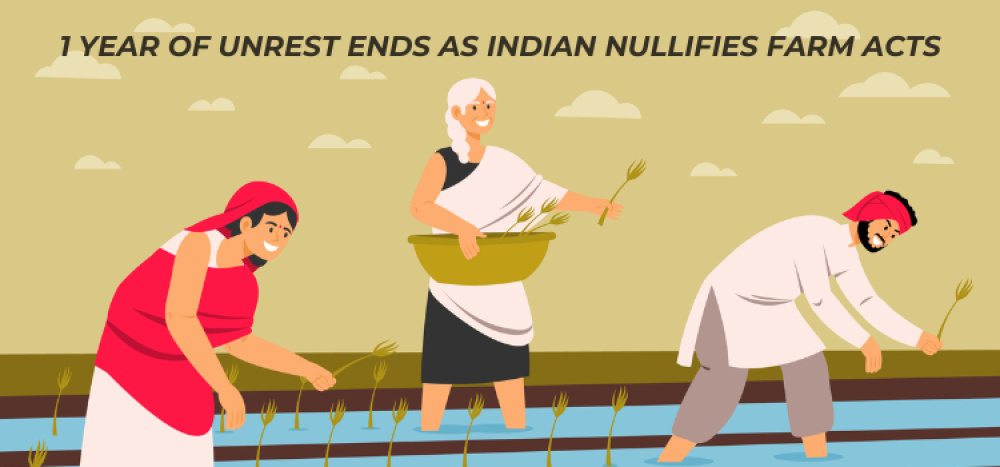
「 ✦ Content ✦ 」
These laws, introduced in 2020, aimed to transform India’s agricultural landscape but faced fierce opposition from farmers. These laws, which were in force for only 221 days from September 2020, included the Farmers’ Produce Trade and Commerce (Promotion and Facilitation) Act, 2020, the Farmers (Empowerment and Protection) Agreement of Price Assurance, Farm Services Act, 2020, and the Essential Commodities (Amendment) Act, 2020.
The farm laws opened several opportunities for the farmers while it closed several others. The reforms allowed farmers to sell their produce directly to private players, bypassing the traditional government-controlled wholesale markets. The supporters argued that this would enhance efficiency and provide better prices for farmers. At the same time, the critics feared that it would weaken farmers’ bargaining power and expose them to market volatility. Furthermore, the farm laws permitted private buyers to stockpile essential food items for future sales. The advocates of legislation believed this would encourage investment and reduce wastage, whereas the detractors worried about potential hoarding and price manipulation.
The reforms included market-driven prices over the MSP, which guaranteed a minimum price for certain crops. Farmers feared that private players would dictate prices, leaving them vulnerable as the MSP had been a lifeline for many small and marginal farmers.
Farmers from predominantly Punjab, Haryana, and Uttar Pradesh led protests at the borders of Delhi for several weeks. Their demands included the repeal of the farm laws and legal assurance for the MSP. During the protests, many dozens of farmers lost their lives due to harsh weather conditions and Covid. The protests gained momentum, drawing international attention and making the movement a symbol of resilience and determination.
The government finally decided to take a U-Turn from the implemented farm laws due to the protests and their consequences. The Indian Prime Minister Narendra Modi announced the repeal of three farm laws, acknowledging the farmers’ concerns by the introduction of the Farm Laws Repeal Bill, 2021. This decision came after a year of sustained protests and political pressure. The repeal was announced on Guru Nanak’s birth anniversary, a significant day for Sikhs, that is, on November 19, 2021.
The repeal addressed the farmers’ immediate worries and brought a sense of relief to them. Farmers are the backbone of our country and this act of repealing proved that the nation considers them as valuable contributors to the community and national economy. It restored the faith of farmers in dialogue and democratic processes. Although the legislations were repealed, there are challenges ahead, such as ensuring fair prices, modernizing agriculture, and empowering the farmers. The attempt to balance market reforms with social welfare has continued to remain a delicate and challenging task.
The repeal of the farm laws marks a turning point in India’s agricultural history. It reflects the power of collective voices and the need for inclusive policy-making. As the dust settles, the focus shifts to building a sustainable and equitable farming ecosystem, one that honors tradition while embracing progress.
OLQ is a Pan - India basis law firm connecting legal expertise nationwide.
WRITTEN BY - MARIA THERESE SYRIAC GUIDED BY - ADVOCATE ANIK


