
UNPACKING BRAHMANICAL PATRIARCHY: HOW INDIA'S LEGAL FRAMEWORK PERPETUATES CASTE AND GENDER INEQUALITY
Category: ARTICLE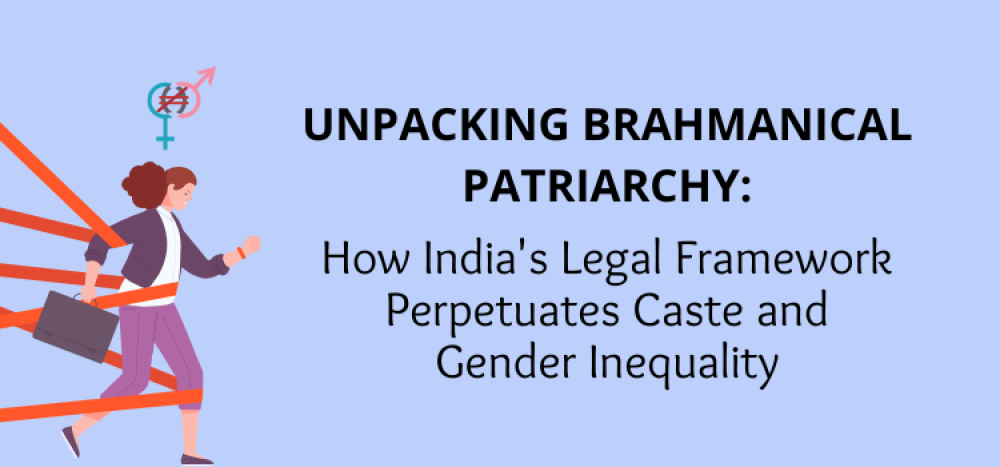
「 ✦ Content ✦ 」
While India does have anti discrimination laws in place up to this present day, majority of these laws are a reflection of the unfair system that prevailed in the earlier years. This article focuses on how the Indian law, as progressive as it is to provide equality has hidden vices that perpetuate the vices of casteism and sexism. Looking at the important laws and important cases, we will understand how systemic these problems are and why reform is still required.
Key words : Anti discrimination , Brahmanical patriarchy, casteism.
INTRODUCTION
India's social structure has long been shaped by Brahmanical patriarchy, a system that enforces both caste and gender hierarchies. This dual oppression places women, especially those from lower castes, in particularly vulnerable positions. Despite India's efforts to promote equality through its legal framework, the influence of this patriarchal system persists. This article explores how India's laws, while progressive in intent, often reinforce the very caste and gender inequalities they aim to eliminate. By delving into the concept of Brahmanical patriarchy and examining key legal cases and statutes, we aim to understand why true equality remains elusive and what can be done to address these entrenched issues.
UNDERSTANDING BRAHMANICAL PATRIARCHY
Brahmanical patriarchy refers to the social system where the upper caste, particularly Brahmins, maintain dominance by imposing rigid gender roles and caste hierarchies. This system ensures that power remains concentrated within the upper castes while simultaneously oppressing women, particularly those from lower castes. In this context, women are expected to uphold the honor of the family and community by adhering to strict codes of conduct, further entrenching their subservience. The intersectionality of caste and gender in Brahmanical patriarchy means that women from lower castes face a double burden of discrimination. They are marginalized not only because of their gender but also because of their caste, making their social mobility and access to resources even more limited.
This system is deeply embedded in India's social fabric, influencing not just societal norms but also the functioning of institutions, including the legal system. The persistence of Brahmanical patriarchy means that any attempt to address gender inequality must also consider the caste dimension, and vice versa. Understanding this intersectionality is crucial for any meaningful progress towards equality in India.
THE LEGAL FRAME WORK AND ITS SHORTCOMINGS
India's Constitution is one of the most progressive in the world, promising equality and justice for all its citizens. The Preamble itself speaks of "justice, social, economic and political" and "equality of status and opportunity." Various laws have been enacted to protect marginalized groups, including the Scheduled Castes and Scheduled Tribes (Prevention of Atrocities) Act, 1989, which aims to prevent atrocities against Dalits and Adivasis, and the Protection of Women from Domestic Violence Act, 2005, which seeks to safeguard women from domestic abuse.
However, these laws often fail to achieve their intended outcomes due to several reasons. First, the implementation of these laws is often weak, particularly in rural areas where caste hierarchies are more rigidly enforced. Law enforcement officials themselves may hold biases that prevent them from effectively carrying out the laws. Second, the legal system in India is overburdened, leading to delays in the delivery of justice. For many marginalized groups, these delays can be tantamount to a denial of justice. Lastly, the laws themselves, while well-intentioned, are sometimes rooted in the same patriarchal and casteist values they are supposed to dismantle. For instance, while the Protection of Women from Domestic Violence Act, 2005, is a significant step forward, its effectiveness is often undermined by the societal stigma attached to women who seek legal recourse against their husbands or family members.
CASE LAWS .
Several landmark cases in India's legal history highlight the challenges of dismantling Brahmanical patriarchy within the legal system. For instance, in State of Maharashtra v. Madhukar Narayan Mardikar (1991), the Supreme Court ruled that even a woman of "easy virtue" has the right to privacy, and her moral character cannot be used to deny her this right. While this judgment was a progressive step in protecting women's rights, it also inadvertently highlighted the societal biases that equate a woman's worth with her sexual conduct, a concept deeply rooted in Brahmanical patriarchy.
In another significant case, Nandini Sundar v. State of Chhattisgarh (2011), the Supreme Court addressed the state's use of tribal people in anti-Naxal operations, condemning the practice as a form of systemic oppression of lower castes. The Court's ruling was a strong statement against the exploitation of vulnerable communities; however, it also underscored the ways in which state power can perpetuate caste hierarchies. The case brought to light the state's role in reinforcing these social structures, often under the guise of law and order.
The case of Navtej Singh Johar v. Union of India (2018), which decriminalized homosexuality in India, is another example where the legal system had to confront deeply entrenched societal norms. While not directly related to caste, the case is significant in the context of Brahmanical patriarchy because it challenged the rigid gender roles and norms that are central to this system. The judgment was a major victory for LGBTQ+ rights in India, but it also highlighted the slow pace of change when it comes to dismantling entrenched social structures.
HOW LAWS PERPETUATE INEQUALITY
Even laws that appear neutral can perpetuate caste and gender inequalities when applied within a society steeped in Brahmanical patriarchy. The Hindu Succession Act, 1956, which was amended in 2005 to give daughters equal rights to ancestral property, is a case in point. While the amendment was a significant step towards gender equality, its implementation has been uneven, particularly in rural areas where patriarchal norms are stronger. Many women, especially from lower castes, face immense social pressure to forfeit their inheritance rights in favor of their brothers or other male relatives. This pressure often comes from within the family and community, making it difficult for women to claim their legal rights.
Similarly, the dowry prohibition laws, while intended to curb the practice of dowry, often fail to address the underlying patriarchal attitudes that perpetuate this practice. In many cases, the enforcement of these laws is weak, and the social stigma attached to reporting dowry harassment further discourages women from seeking legal redress. Moreover, these laws sometimes lead to unintended consequences, such as false accusations, which can undermine the credibility of genuine cases and perpetuate the stereotype that women misuse legal provisions for personal gain.
THE NEED FOR REFORM .
Addressing caste and gender inequality in India requires more than just legal reforms; it requires a fundamental shift in societal attitudes. Legal reforms must go beyond the mere drafting of progressive laws and focus on their effective implementation. This includes better training for law enforcement officials to ensure that they are free from caste and gender biases, as well as stricter monitoring of how laws are enforced, particularly in rural areas where caste hierarchies are more deeply entrenched.
Moreover, there needs to be a greater focus on raising awareness about legal rights among marginalized communities. Many people, particularly women from lower castes, are unaware of their rights and how to access legal recourse. Legal literacy programs, particularly in rural areas, could play a crucial role in empowering these communities and ensuring that they can claim their rights.
Finally, there must be a more nuanced understanding of how caste and gender intersect in the Indian context. Legal scholars and policymakers need to recognize that caste and gender cannot be treated as separate issues, as they are deeply intertwined. Any legal framework that seeks to address inequality must consider the ways in which these two forms of discrimination reinforce each other.
CONCLUSION .
Brahmanical patriarchy continues to be a significant barrier to achieving true equality in India. While the legal framework has made significant strides in protecting marginalized groups, it still falls short in many areas due to deep-seated societal biases and systemic issues. For India to move forward, it must not only reform its laws but also challenge the societal norms that perpetuate caste and gender inequality. Only through a comprehensive approach that addresses both the legal and social dimensions of these issues can the promise of equality for all be fully realized.
REFERENCE.
1,State of Maharashtra v Madhukar Narayan Mardikar, 1991 AIR 207
2. Nandini Sundar v. State of Chhattisgarh, (2011) 7 SCC 547
OLQ is a Pan-India basis law firm connecting legal expertise nationwide.
WRITTEN BY: ABHISHEK AIYAPPA
GUIDED BY: ADVOCATE ANIK


