
THE PROTECTION OF PATIENT PRIVACY: RECENT ADVANCES IN INDIA'S HEALTHCARE DATA PROTECTION LAWS
Category: ARTICLE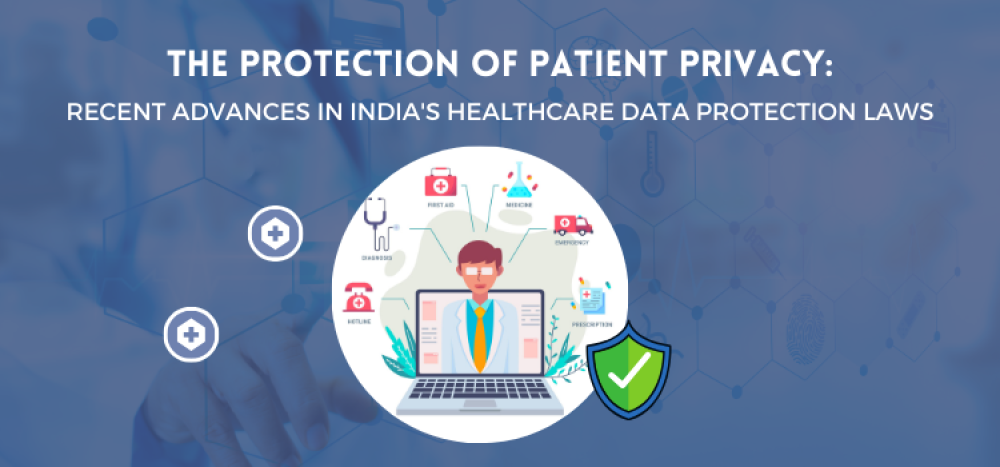
「 ✦ Content ✦ 」
In this regard, it talks about the legislative activities such as the Digital Personal Data Protection Act, 2023, and DISHA, which provide a framework for protecting patient data. Some of the main provisions focus on the requirements for obtaining clear and active consent, patient’s rights guaranteed, and regulatory agencies for compliance. The article also covers the ethical issues of health privacy, the violation of data security, and the necessity of strong measures. The rationale for these laws is to rebuff doubts in relation to the healthcare system and enhance human health standards.
KEYWORDS: Patient privacy, Healthcare data protection laws, Electronic health records (EHRs), Digital Personal Data Protection Act, 2023, Digital Information Security in Healthcare Act (DISHA)
Data Protection Authority.
INTRODUCTION:
Recent years have seen increased implementation of EHRs, telemedicine and other digital technologies with significant benefits in patient care but with threats of data breaches and unauthorized access to patient’s health information. Protection of patient information is a cause of considerable concern for the healthcare practitioners, law makers, and the public. The protection of healthcare data in India has spurred greater development in data protection laws through concepts of legislative enactments and protective regulations.
These measures are critical in fostering patient and doctor rapport and are in line with international data privacy laws such as the General Data Protection Regulation in Europe. The increasing number of threats, the design and nature of healthcare IT systems and patients’ awareness of their rights in this regard contributed to the need for stronger protection measures. To this effect, the COVID-19 pandemic has escalated the use of digital health solutions, thus increasing the importance of strong data privacy laws.
HEALTH PRIVACY – AN ETHICAL CHALLENGE:
The ability to retain one’s health information, details or records secret and away from the public domain is referred to as the concept of health privacy. This involves; personal health data, health care history, diagnostic results, and other health information generated in the process of delivering health services. Privacy in health is important to prevent outside intervention on one’s lives and also to build trust between patients and the health care providers.
Confidentiality is an important aspect of trust between a patient and a provider where patients give out the necessary information to their providers since they expect their information to be kept a secret. This is primarily because of health literacy where the ability to read health information, understand it and turning it into action results in improved health. Preserving the health status of an individual is not only being moral, but also legal for anyone providing healthcare services.
Privacy in healthcare comes to the limelight in India’s case of Mr X versus Hospital Z in 1998, where revealing his HIV+ status led to the cancellation of marriage. The court ruled that doctors are under obligation not to disclose their patient’s secrecy, but the public interest shall be a reason to break the duty especially in cases where there is concern with the harm that may be resulting to the others in the near future or at the current time. In another case, the Supreme Court of India held that unauthorised disclosure of medical records by a hospital is violet privacy.
ANALYSIS OF KEY PROVISIONS OF INDIA’S DATA PROTECTION FRAMEWORKS:
India has introduced some legal measures to protect data and personal information with increasing focus on data security in the digital world. India’s main IT legislation, the IT Act of 2000, was one of the first pieces of legislation to tackle data protection specifically in light of cybercrimes and electronic commerce. The Personal Data Protection Bill, 2019 (PDP Bill), is a systematic approach towards the establishment of data protection law in India, specifically, aiming to enshrine the consent as an essential and significant basis to process the personal data, particularly sensitive one. It entitles the individual with the right to access, rectify the information, erase the information and even right to data portability and the right to be forgotten.
The Electronic Health Record Standards for India in the year 2016 and the Digital Information Security in Healthcare Act (DISHA) is the law that guides the protection of electronic health records in India. The Health Data Management Policy, 2020, is also cantered on the rights of the patients, keeping of their identity, and a Secured environment.
THE DIGITAL PERSONAL DATA PROTECTION ACT, 2023:
The Digital Personal Data Protection Act, 2023 allows processing of personal health data only if consent is explicitly given and this brings confidence between the patients and the healthcare givers. It sets up a Data Protection Authority that’s in charge of monitoring and implementation of these rules and regulations; it also tackles the data localization policy, which mandates local storage and processing of sensitive health data in India.
The Digital Personal Data Protection Act, 2023, outlines two main grounds for processing personal data in India:
consent from data principals and
certain "legitimate uses.
Consent can be given for any lawful purpose, however, necessity test establishes the necessity of the particular processing activity. The Act also contains some examples to help with its application, execution of activities involving the processing of personal data for certain purposes for which the Data Principal has provided her data to the Data Fiduciary without indicating her consent.
The Act also provides strict guidelines for protecting health information from uses or disclosures that may constitute a breach of security and those are in the form of encryption, risk analyses, and periodic security reviews among other cyber security features. The above mentioned provisions greatly improve the health data protection in India, uphold patients’ rights to privacy, and strengthen community’s confidence in the healthcare field.
CONCLUSION:
In a nutshell I would like to conclude that, currently India has proposed some legislation that seeks to shape patient data protection in the digital health environment, including the Digital Personal Data Protection Act, 2023 and the Digital Information Security in Healthcare Act (DISHA). These laws focus on the written and informed consents and patents’ rights relating to the accessing, correcting, deletion or transfer of health information.
There are government policing institutions such as the Data Protection Authority and the National Electronic Health Authority to uphold data protection policies. Laws such as data localization can be put in place to regulate cross-border data transfer and misuse, whereas the health-related institution uses integrity measures such as encryption and auditing of data to deal with cyber threats when dealing with the health information of people.
REFERENCES:
1. 1998 (8) SCC 296, Mr X v Hospital Z
2. 2019 (1) SCC 1 Justice K.S. Puttaswami and another vs. Union of India.
3. Mani T. Privacy in Healthcare: Policy Guide. Centre for Internet and Society. Centre for Internet and Society website. https://editors.cis-india.org/internetgovernance/blog/privacy-healthcare.pdf
OLQ is a Pan-India basis law firm connecting legal expertise nationwide
WRITTEN BY: ABHISHEK S CHAUHAN
GUIDED BY: ADVOCATE ANIK


