
THE GUJARAT HIGH COURT RULES AGAINST UNILATERAL FEE INCREASE BY ARBITRAL TRIBUNALS
Category: Legal News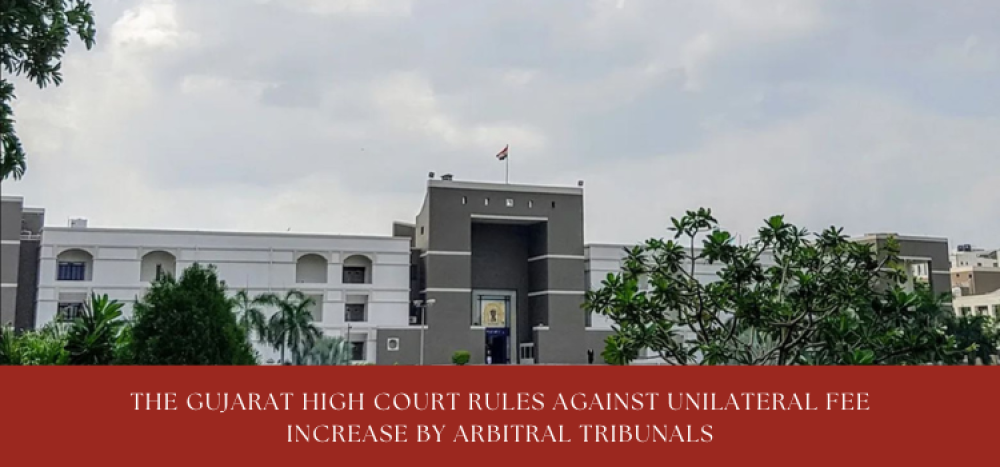
「 ✦ Content ✦ 」
This decision lays down the fact that it is proper that parties to a dispute retain full control over the proceedings of arbitration to the extent that arbitral bodies do not take advantage of that control and hold themselves in a position of domination over parties to a dispute.
The Case and the Court's Ruling
This decision was given when an attempt was made by the arbitral tribunal to raise the fees charged in the case without the consent of the contracting parties. In the recent judgment in DIRECTOR AAWORD v. CHRIST UNIVERSITY, Gujarat High Court, comprising of the bench of Chief Justice Justice Sunita Agarwal and Justice Aniruddha P. Mayee has observed that such unilateral fee increase itself is a violation of basic principles of arbitration as it mandates that the parties and the tribunal must be in agreement on such matters.
The court said that the arbitration fees should be determined by the parties in the arbitration agreement and they have the right to determine the amount of money to be paid to the arbitrators. Thus, the arbitral tribunal cannot unilaterally enhance the fees claiming it to be the most reasonable approach as such an action is potentially inimical to the parties’ liberty and the voluntary character of arbitration.
Alignment with Supreme Court Precedent:
It should be noted that the presented judgment correlates with the general legal guidelines outlined by the Supreme Court of India. Lately, the Supreme Court decided that in the Fourth Schedule of the arbitration and Conciliation Act Rs 30,00,000 ceiling is for the sum of base amount and variable amount and not for the variable amount alone. The court also clarified that this ceiling is per arbitrator in respect of which apply, where there are three or more arbitrators in the arbitral tribunal.
Gujarat High Court ruling also strengthens the notion that the arbitral authorities have to respect the provisions of the contract entered by the contract parties. Anything that seeks to alter these terms; for instance, trying to modify the fees upwards without the consent of the other party, is likely to be met with legal action and is likely to be deemed to have been unwritten by the courts.
Significance for Gujarat's Arbitration Landscape:
This ruling is especially valuable in understanding conditions in Gujarat, where the activity of companies and the incidence of complicated disputes have increased. The formation of the Arbitration Centre that operates under the High Court of Gujarat will help in having better flexible, less expensive and speedy arbitration. It is believed that the application of institutional arbitration in Gujarat will also improve on the efficiency and fairness especially where the parties to a contract seek legal redress to their disputes.
Conclusion:
This case shows that Gujarat High Court has emphasized the requirement of preserving the purity of the arbitral process by requiring arbitral tribunals to work within the confines of the contracted terms and conditions. Insofar, this ruling peremptorily will benefit the arbitration climate in the Gujarat state and influence the domestic and global investors’ boost in the very specific region concerning the arbitration proceedings.
OLQ is a Pan-India basis law firm connecting legal expertise nationwide.
WRITTEN BY: ABHISHEK S CHAUHAN
GUIDED BY: ADVOCATE ANIK


