
THE DISCUSSION ON ELECTRONIC VOTING MACHINES (EVMS) VERSUS TRADITIONAL PAPER BALLOTS
Category: ARTICLE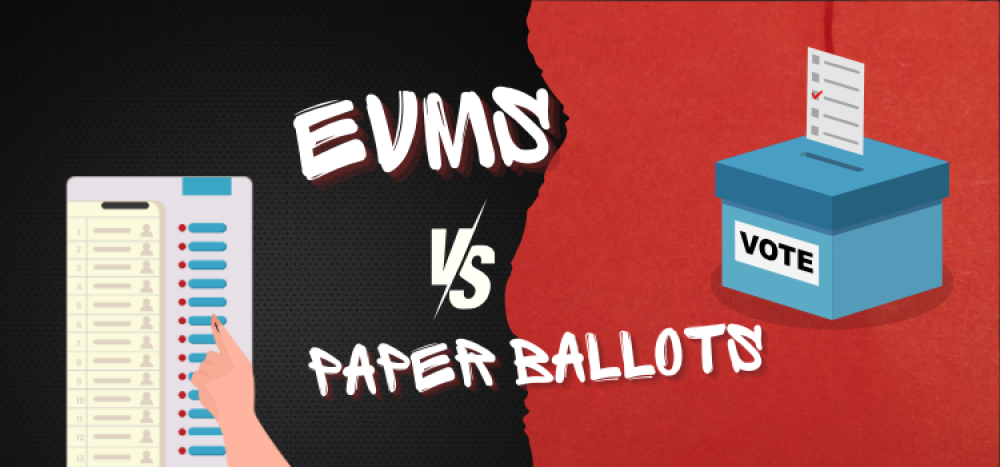
「 ✦ Content ✦ 」
On April 16, 2024, the Supreme Court of India reaffirmed its support for EVMs, asserting their ability to deliver “absolutely accurate results” free from human bias. This endorsement came despite petitions from the Association for Democratic Reforms (ADR) and Arun Kumar Agarwal, who advocated for either a return to paper ballots, enhanced Voter Verifiable Paper Audit Trail (VVPAT) systems, or a more comprehensive verification of VVPAT slips. The Court rejected the proposal to revert to paper ballots, citing historical drawbacks and inefficiencies in manual counting. It emphasized that evaluations of EVM performance should rely on data from the Election Commission rather than external opinions. The Court’s stance underscores the ongoing challenge of balancing technological advancements with traditional voting methods to ensure electoral transparency and public confidence.
INTRODUCTION
The debate between Electronic Voting Machines (EVMs) and paper ballots is a significant topic in electoral reform, underscoring concerns about voting system integrity and efficiency. Recently, the Supreme Court of India reaffirmed its support for EVMs, noting their benefits in terms of simplicity, security, and ease of use. This decision follows a petition from the Association for Democratic Reforms (ADR), which advocated for either reverting to traditional paper ballots, enhancing voter verification with Voter Verifiable Paper Audit Trail (VVPAT) slips, or increasing the counting of VVPAT slips to strengthen trust in the electoral process.
The ADR argues that voter verification is a fundamental right and suggests that EVMs, despite their technological advantages, may not fully address issues of electoral transparency and public confidence. Conversely, the Election Commission of India (ECI) defends EVMs by highlighting their effectiveness in preventing fraud, reducing human error, and speeding up the voting and counting process. The ECI also points out that EVMs alleviate the logistical problems associated with paper ballots and decrease the likelihood of invalid votes.
This ongoing debate reveals the struggle between adopting technological advancements and preserving traditional voting methods, reflecting global discussions on ensuring fair, transparent, and reliable elections. As both perspectives offer strong arguments, the outcome of this discourse will likely influence future electoral reforms and impact public trust in democratic processes.
WHAT IS BALLOT PAPER
A ballot paper is a physical document used in traditional voting systems where voters mark their choice among listed candidates or options. This method has been widely used globally due to its long history and simplicity. When voters arrive at the polling station, they receive a ballot paper that details the candidates or choices available. This practice was standard in India from its first general elections in 1951-52 through the 1990s. Voters mark their choice in secrecy and submit the completed ballot into a sealed box for later counting. This method is valued for its transparency and ease of use but has faced challenges such as potential fraud, tampering, and the labor-intensive nature of counting votes manually.
WHAT ARE EVMS AND VVPAT?
Electronic Voting Machines (EVMs) were first introduced in India in 1982 for a by-election in Kerala, though initially limited to a few polling stations. The Representation of People's Act of 1951 was amended in 1989 to permit electronic voting, but EVMs were not used nationwide until 1998, when they were employed in 25 state assembly constituencies. By 2004, EVMs were utilized for all 543 parliamentary constituencies in the General Elections.
The Voter Verifiable Paper Audit Trail (VVPAT) system was later introduced to enhance the EVM process. VVPAT allows voters to verify their vote by providing a printed slip of their choice, which falls into a sealed box attached to the VVPAT. The Supreme Court mandated the phased introduction of VVPATs in 2013, calling them crucial for ensuring free and fair elections. VVPAT was first used in a by-election in Noksen, Nagaland, in 2013, and in eight Lok Sabha constituencies in 2014.
An EVM consists of three units: the ballot unit, the control unit, and the VVPAT. The ballot unit functions like a keypad with 16 keys for voters to select their preferred candidate or party. The control unit, managed by the polling officer, communicates with the VVPAT, which prints a slip of the vote and deposits it into a VVPAT box. The VVPAT's fall sensor confirms the vote to the control unit, which records it.
EVMs are manufactured by two public sector enterprises: Electronic Corporation of India Limited (under the Department of Atomic Energy) and Bharat Electronics Limited (under the Ministry of Defence). To prevent tampering, EVM software is securely programmed onto a One Time Programmable microcontroller chip during production. Additionally, EVMs undergo two stages of randomization to ensure impartiality and prevent bias. This process, conducted by the EVM Management System software, assigns EVMs to constituencies and polling stations randomly, with political party representatives and Central Observers overseeing the procedure.
DIFFERENCE BETWEEN ELECTRONIC VOTING MACHINES (EVMS) AND BALLOT PAPERS
Voting is a cornerstone of democratic processes, and methods for casting votes have evolved over time. This guide outlines the main differences between traditional ballot papers and modern Electronic Voting Machines (EVMs).
Ballot Papers: The Traditional Method
Ballot papers are physical documents used for voting. Voters mark their choices on these papers at the polling station and deposit them into a secure ballot box.
Advantages:
1. Transparency: Voters can directly view and verify their choices on paper.
2. Simplicity: The voting process is straightforward and does not require any technical skills.
3. Physical Record: Ballot papers provide a tangible record that can be reviewed or recounted if needed.
Disadvantages:
1. Time-Consuming: Counting ballot papers is slow and labor-intensive, leading to potential delays in results.
2. Human Error: The manual counting process is susceptible to inaccuracies and mistakes.
3. Logistical Issues: The process of printing, distributing, and managing large quantities of paper ballots can be expensive and complicated.
Electronic Voting Machines (EVMs): The Modern Approach
EVMs are electronic devices that record and store votes digitally. Voters use buttons or touchscreens to select their preferred candidates, and votes are recorded electronically.
Advantages:
1. Efficiency: EVMs streamline both voting and counting, resulting in quicker election results.
2. Accuracy: Electronic recording reduces human error and ensures precise vote capturing.
3. Cost-Effective: Over time, EVMs can lower costs associated with paper and manual labor.
Disadvantages:
1. Security Concerns:There are concerns about potential tampering or hacking, which could jeopardize the integrity of the vote.
2. Technological Barriers: EVMs may be challenging for some voters to use, particularly those who are less familiar with technology.
3. Initial Costs: The initial investment in EVM technology can be significant.
SUPREME COURT SUPPORTS EVMS, DISMISSES PAPER BALLOTS PROPOSAL
On April 16, 2024, the Supreme Court of India addressed the ongoing debate over Electronic Voting Machines (EVMs) and paper ballots. The Court rejected the proposal to revert to paper ballots, asserting that EVMs provide “absolutely accurate results” when not subject to human bias.
KEY POINTS:
EVM Accuracy: Justice Sanjiv Khanna, leading the two-judge Bench, highlighted that EVMs, when free from human intervention, produce precise results. The Court is open to reviewing the actual performance of EVMs using data from the Election Commission, rather than relying on external opinions.
Dismissal of Paper Ballots: The Court dismissed calls for a return to paper ballots, citing the historical issues and inefficiencies associated with manual voting. Justice Khanna pointed out the drawbacks of the previous system.
Petitioners' Concerns: The petitions from the Association for Democratic Reforms (ADR) and Arun Kumar Agarwal raised concerns about the EVMs’ lack of voter verification. They argued that the current Voter Verifiable Paper Audit Trail (VVPAT) system, which briefly shows the vote, fails to adequately reassure voters.
Proposed Alternatives: Advocate Prashant Bhushan suggested several alternatives, including returning to paper ballots, allowing voters to keep VVPAT slips, or making VVPAT screens transparent. The petitioners also called for a 100% verification of VVPAT slips against EVM votes.
Court’s Emphasis on Data: The Court stressed the need to assess EVM performance based on data rather than opinions. Justice Khanna emphasized that any discrepancies in past elections should be investigated using factual data.
Contextual Remarks: Justice Dipankar Datta recognized the scale of Indian elections compared to countries like Germany, indicating that while errors are possible, the robustness of the system and the accountability of the Election Commission should be trusted.
CONCLUSION
In conclusion, the Supreme Court's recent decision reinforces the validity of Electronic Voting Machines (EVMs) as a reliable tool for modern elections, emphasizing their capacity to produce accurate results when free from human interference. The Court’s rejection of the proposal to revert to paper ballots underscores the historical inefficiencies and challenges associated with manual voting systems. Despite the concerns raised by the Association for Democratic Reforms (ADR) and other petitioners about voter verification and transparency, the Court has advocated for relying on data-driven evaluations of EVM performance. This decision reflects a broader global struggle between adopting advanced technology and maintaining traditional methods. As the debate continues, it will shape future electoral reforms and impact public trust in the democratic process, highlighting the need for ongoing scrutiny and improvements in voting technologies to address both efficiency and transparency concerns.
OLQ is a Pan-India basis law firm connecting legal expertise nationwide.
WRITTEN BY: PRATIKSHA SWAIN
GUIDED BY: ADVOCATE ANIK


