
SUPREME COURT UPHOLDS TRADITIONAL RITUALS IN HINDU MARRIAGES: A REAFFIRMATION OF THE 1955 ACT
Category: Family Law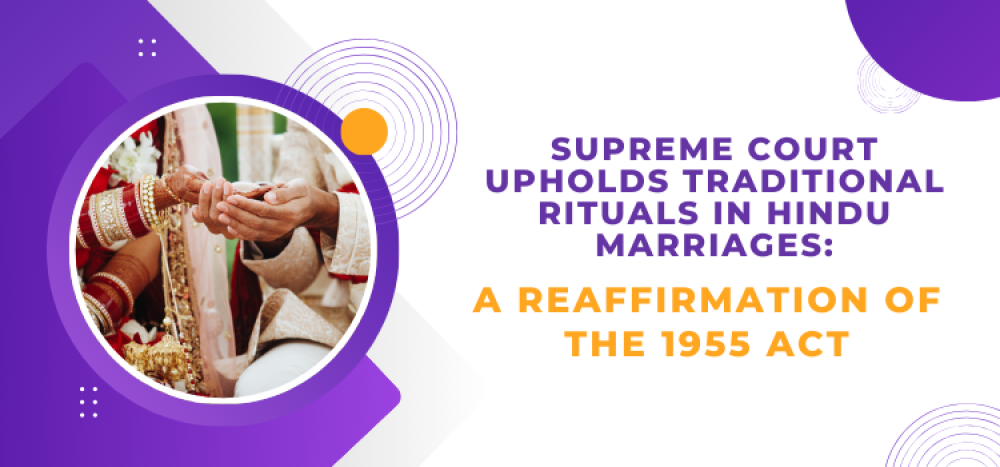
「 ✦ Content ✦ 」
According to the Act, marriages cannot be formally recognised until rituals of saptapadi; it means seven steps around the fire are carried out. The goal of this regulation was to outlaw activities such as polygamy while preserving the sacredness of Hindu weddings. The need for these customs was reinforced by a recent Supreme Court decision, which emphasised that marriage is a sacrament with deep historical roots rather than merely a ceremonial ceremony.
Introduction
According to the Supreme Court, a Hindu marriage is a sacred ceremony that must be performed in line with the traditional rites and ceremonies outlined in the Hindu Marriage Act. It made clear that this ceremonies and rituals had to be adhered to precisely, otherwise the marriage would be deemed void even after it was officially registered.
In Hinduism marriages must adhere to specific rituals in order to be legally recognised. These rites are outlined in Section 7 of the Hindu Marriage Act and may be based on the traditions and customs of either partner. If this rituals are not performed, the marriage will not be regarded as lawful.
We also note that Hindu marriages have a sacred quality and sacraments. According to the Rig Veda in the setting of saptapadi in a Hindu marriage, the bridegroom declares to his bridenWith seven steps we have become friends . after finishing the seventh step. I hope to become friends with you and that our friendship will never cease. The statement read, “A wife is regarded as half of oneself (ardhangini) but she must also be accepted as an equal partner in the marriage and have her own identity.
The monogamy is the only kind of marriage that is deemed lawful for a husband and wife. all other kinds of relationships, including polyandry and polygamy, have been outlawed under the Hindu Marriage Act. The Parliament also intends for there to be just one type of marriage with a variety of customs, and rituals.
Key aspects
The court stressed that a Hindu marriage must adhere to customary rites, especially the “saptapadi” seven steps around the fire, in order for it to be legally recognised.
The decision upheld Hindu marriages’ status as holy ceremonies with a strong religious foundation, rather than merely social contracts.
The Court made it clear that, even if they are recorded, marriages that do not follow these rites are not recognised by Hindu law.
Conclusion
The ruling by the Supreme Court emphasises how important it is for Hindu marriages performed in accordance with the Hindu Marriage Act of 1955 to follow customary practices. The decision makes it clear that a marriage must follow the necessary rituals and procedures listed in the Act in order for it to be recognised legally. This highlights how crucial it is to uphold customs within the legal system so that marriages are recognised in accordance with both cultural and legal norms. In keeping with legal requirements, the Court’s confirmation upholds the sanctity and integrity of these rites, which are meant to maintain the traditional core of Hindu marriages.
OLQ is a Pan-India basis law firm connecting legal expertise nationwide
WRTTEN BY: MELVIN SUJAY
GUIDED BY: ADVOCATE ANIK


