
Sexual Assault Under POCSO Can't Be Quashed Based On 'Compromise', Offence Is Heinous & Not Of Private Nature : Supreme Court
Category: Criminal Law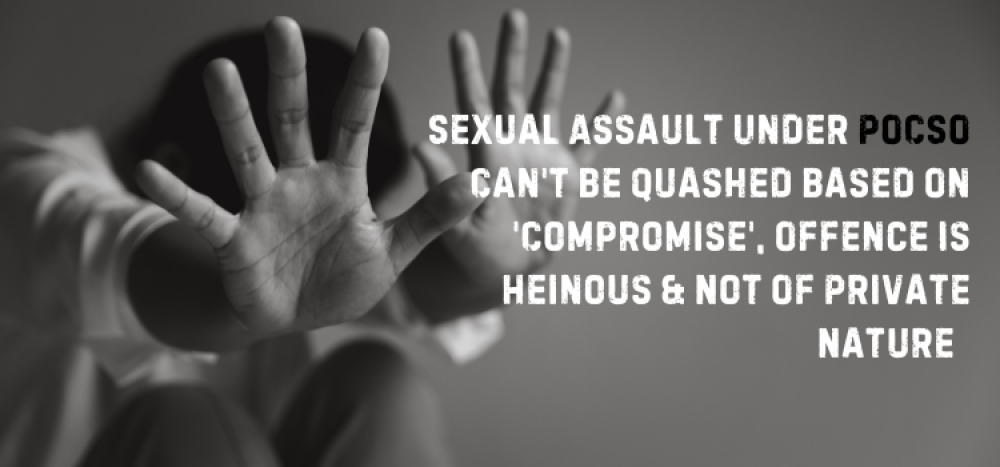
「 ✦ Content ✦ 」
Introduction
The recent ruling by the Supreme Court of India that POCSO Act does not allow quashing of cases involving sexual assault merely on compromise between parties. The judgment clearly focuses on the heinousness of the offenses This judgement gives greater importance to the protection of children from being vulnerable than allowing individual settlements, highlighting the heinous nature of these crimes and their societal impact.
Background
The case began when a government school teacher, Vimal Kumar Gupta, was accused of sexually harassing a 15-year-old Dalit girl in Rajasthan. Her father lodged a police complaint, following which an FIR was registered under the POCSO Act and the SC/ST (Prevention of Atrocities) Act. Subsequently, the family and Gupta reached a compromise and the Rajasthan High Court dismissed the FIR on account of this compromise. However, Ramji Lal Bairwa, a social worker, challenged this dismissal, arguing that allowing such compromises weakens the seriousness of sexual offenses against minors.
Key Aspects
1. Supreme Court's Ruling: On 7 November 2024, a bench led by Justices CT Ravikumar and PV Sanjay Kumar ruled that sexual assault cases under POCSO cannot be quashed based on compromises as this is not merely a private matter and this has serious implications for society at large. The judgment referred to previous judgements like Gian Singh v. State of Punjab (2012) where it established a clear stance against quashing serious criminal charges based on compromises, particularly in cases involving vulnerable individuals like children. It also pointed out the fact that such judgments of the court should have a far-reaching impact on society.
2. Nature of Offense: The Supreme Court termed the act of rubbing a minor's breast as serious sexual assault under Section 7 of the POCSO Act. In the judgment, the bench stressed the fact that such acts should not be taken lightly or viewed as mere issues of domestic disputes. The Court stated that such acts have far-reaching implications on the victim's mental and emotional well-being, which should be addressed at the social level rather than a mere legal one.
3. Public Interest: The judgment establishes the fact that POCSO cases are not ordinary cases of personal grievances but involve public interest, because it deals with the safety and protection of children. The Court, in its reasoning, insisted that allowing compromises could undermine the legislative intent in the POCSO Act.
Conclusion
The Supreme Court's judgement is a significant step in strengthening the laws created to protect children from sexual abuse. In refusing to entertain a case, where compromise would be cited as justification for dismissing serious charges under the POCSO Act, the court has demonstrated its commitment to dealing with these crimes seriously. This ruling sends a clear message that sexual assault is not just a private issue but a crime against society that requires accountability and justice. The verdict will further define future cases of this kind by providing protection and justice to the victim rather than influencing them to settle in ways that undermine their rights and dignity.


