
HIGH COURT OF CHHATTISGARH DISMISSES PETITION TO QUASH CRIMINAL PROCEEDINGS IN CORRUPTION CASE
Category: JUDGEMENT REVIEW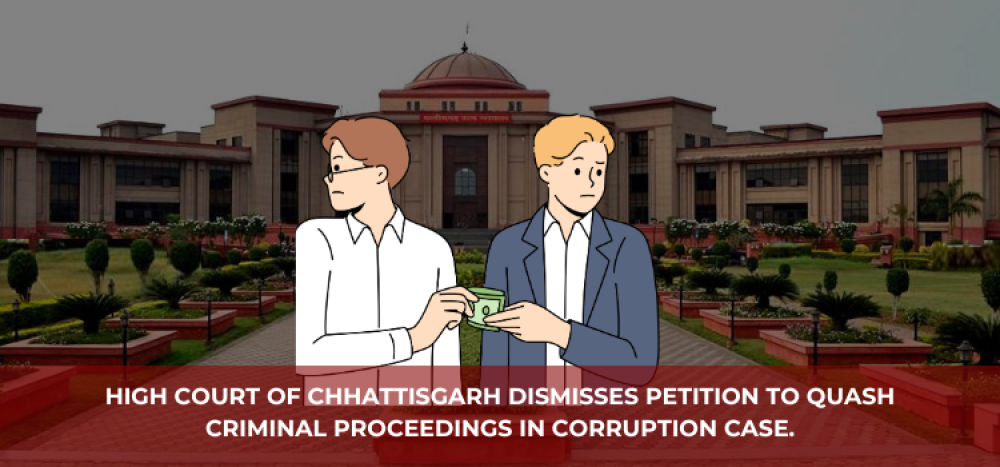
「 ✦ Content ✦ 」
FACTS OF THE CASE
In a recent judgment, the High Court of Chhattisgarh addressed a petition filed by Vinay Kumar Gupta, seeking to quash criminal proceedings against him. The case involved allegations of corruption against Gupta, who works as an Area Organiser under the Office of Assistant Commissioner in the Balrampur-Ramanujganj district of Chhattisgarh.
LEGAL ISSUE
Whether the High Court should exercise its powers under Section 482 of the Code of Criminal Procedure (CrPC) to quash the criminal proceedings and charge-sheet filed against the petitioner?
LEGAL PROVISION
Section 482 of the Code of Criminal Procedure, 1973 - The exercise of inherent powers by the High Court for securing the ends of justice or for the prevention of abuse of the process of any court.
ARGUMENTS OF PETITIONER
The learned counsel for petitioner argued that the trial was already in progress, with evidence from 10 out of 16 prosecution witnesses recorded. They contended that there were additional legal issues that needed to be raised and considered.
ARGUMENTS OF RESPONDENT
The State, represented by Panel Lawyer Mr. Malay Jain, argued against quashing the proceedings, citing the seriousness of the allegations against the petitioner. The petitioner's lack of grounds for sympathy from the court. The completion of the charge-sheet after thorough evidence collection.
COURT ANALYSIS AND JUDGEMENT
The Division Bench, comprising Chief Justice Ramesh Sinha and Justice Sachin Singh Rajput, carefully considered the arguments and documents presented. The Court concluded that the charge-sheet was filed after proper collection of evidence. Given the facts and circumstances of the case, the court found no compelling reason to interfere with the criminal proceedings. The court dismissed the petition, declining to quash either the charge-sheet or the ongoing criminal proceedings. However, the court noted that the petitioner could raise any relevant legal issues at an appropriate stage before the trial court.
CONCLUSION
The case acts as a reminder that the power to quash criminal proceedings is exercised sparingly and only in cases where there is a clear abuse of the court's process or when it is necessary to secure the ends of justice. In this instant case, the High Court found that the petitioner's case did not meet these high standards, thus allowing the trial to proceed as per the regular course of law.
OLQ is a Pan-India basis law firm connecting legal expertise nationwide. WRITTEN BY - MARIA THERESE SYRIAC GUIDED BY - ADVOCATE ANIK


